
Left: Ironing board, some supplies needed || Right: Folding Table (Link is listed below)
Our October meeting will be 9am-3pm, Saturday, October 22nd, at First United Methodist Church of West Monroe, 1411 Glenwood Dr, West Monroe, LA 71291 . We will meet in the Gym. Pull into the 3rd and last drive and park in the back side parking lot.
Project: Traveling Ironing Boards
If you have another project you would like to work on instead, feel free to join us anyway. Also these boards should only take 40 – 45 minutes, so there will be plenty of time to work on other projects.
We will be making traveling ironing boards Saturday. A few of us have made these in the past and have used different materials, so you can choose your favorite method.
The folding table shown above may be found at http://www.american-quilting.com/blog/?p=1908). With this type of table or a board that cannot take heat or moisture, you want to use something like InsulBrite Insulated Batting to protect your board from warping.
The board shown on the left was made with OSB board, which resists warping. It has been used for more than two years with a lot of heat and steam with no sign of affecting its shape.
** ADDENDUM ** With the OSB Board, I used 2 layers of natural batting with no thermal barrier (such as InsulBrite).
You will need approximately 2 layers of natural batting. I like dense thick cotton batting. If you are using InsulBrite, that will be one of your layers. Just add a layer of natural batting on top.
I have seen many ironing boards covered in quilting cotton fabric, so that is an option. I prefer a heavy tight canvas. Shown above on left, the board is covered in natural canvas, the blue and white stripe is heavy ticking canvas that I may use, the blue and white chevron is an upholstery weight canvas. Whatever you use, make sure it is a natural fiber that can take the heat.
There was some discussion on washing your fabrics ahead of time. You certainly can. There is one benefit of skipping that step when working with a natural fabric. Once you have the fabric stretched and stapled on your board, you can steam the board and it will cause the fabric to shrink on the board for a tight fit.
Tools needed are staple gun and heavy duty staples, hammer and needle nose pliers (for staples that don’t sink or staples that have to be removed). If you have any of these, please bring them. Do not feel you have to buy these. We can share what we have.
If you want to use a flat board, Kathy Huff has indicated she has a board she is cutting for this project, and I will have an OSB board cut for the project. Mine should be approximately 16″ x 16″. I haven’t gotten Kathy’s dimensions yet. Cost should be minimum. Probably $1 or $2 per board depending on total cost. You do need to post on Facebook if you want us to reserve a board for you. I feel we will have board left over, but you never know.
Summary Supplies Needed:
- Board or Folding Table
- Batting (dense thick cotton / InsulBrite .. see paragraph above) (approx 6″ wider than board)
- Canvas (approx 6-8″ wider than board)
- Sissors / Cutting Mat / Rotary Cutter / Ruler (whatever you will use to cut fabric and batting.
If you have these, bring them:
- Staple Gun
- Staples (Needs to go through canvas, batting and board)
- Hammer
- Needle nose pliers or staple remover
Lunch:
I can’t remember if we have someone signed up for lunch, so watch the Facebook page. We may set this one as “everyone bring their own” or “Pizza day”.
If you have any questions, please post them on the Facebook Event page. I will answer as soon as possible. Looking forward to seeing you on the 22nd!


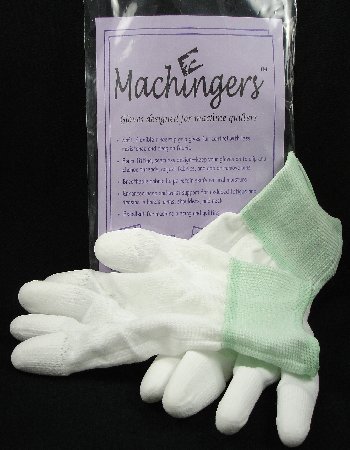 *Machinger Gloves are a specific glove brand, but there are many others. I recently heard someone mention buying cheap gardening gloves instead. Rubber tips on fingers, think surgical gloves, are an option. I find Machinger gloves to be very comfortable to work with and do not cause my hands to get warm. (Amazon has good prices on these as well.)


 Cutting and interfacing your pattern pieces is the last thing to do in preparation for our meeting next week (August 15th). See this
  Binding andZippers Iron your binding and have it ready to apply to bag. I don’t cut my binding to size at this point just so that I have some wriggle room. But I’m sure you will be good if you choose to cut as indicated on pattern. Be sure you have the appropriate zippers for this project. Notions You will need the typical sewing notions for this bag: Thread scissors, pins, binder clips, thread, and needles (90/14 or denim needle would be good). Be sure to bring your zipper foot! If you secure your binding by hand, you will need hand needle. If you have any questions, let me know. See you Saturday! Ramona


 A well loved traditional sampler is the Dear Jane which has been recreated in so many different ways! Many quilts are in the traditional fabrics and colors, there are also two color, high contrast versions, and in recent years I’ve seen this quilt in bright, happy colors. If you haven’t seen all the different versions, a quick search on Pinterest would let you see what I’m talking about.


